
Real World Examples of TFP in Nature and Technology
Real World Examples of TFP in Nature and Technology
The First Pattern™ describes the four recurring moves behind how nature organizes itself. Q1 centers and stabilizes potential, Q2 selects and binds the right pieces into a coherent core. Q3 transforms and activates new states. Q4 exchanges and spreads outwards, allowing information and energy to travel through the environment. These stages help explain how the fundamental forces work and why similar dynamics appear in physics, psychology, biology, and technology.
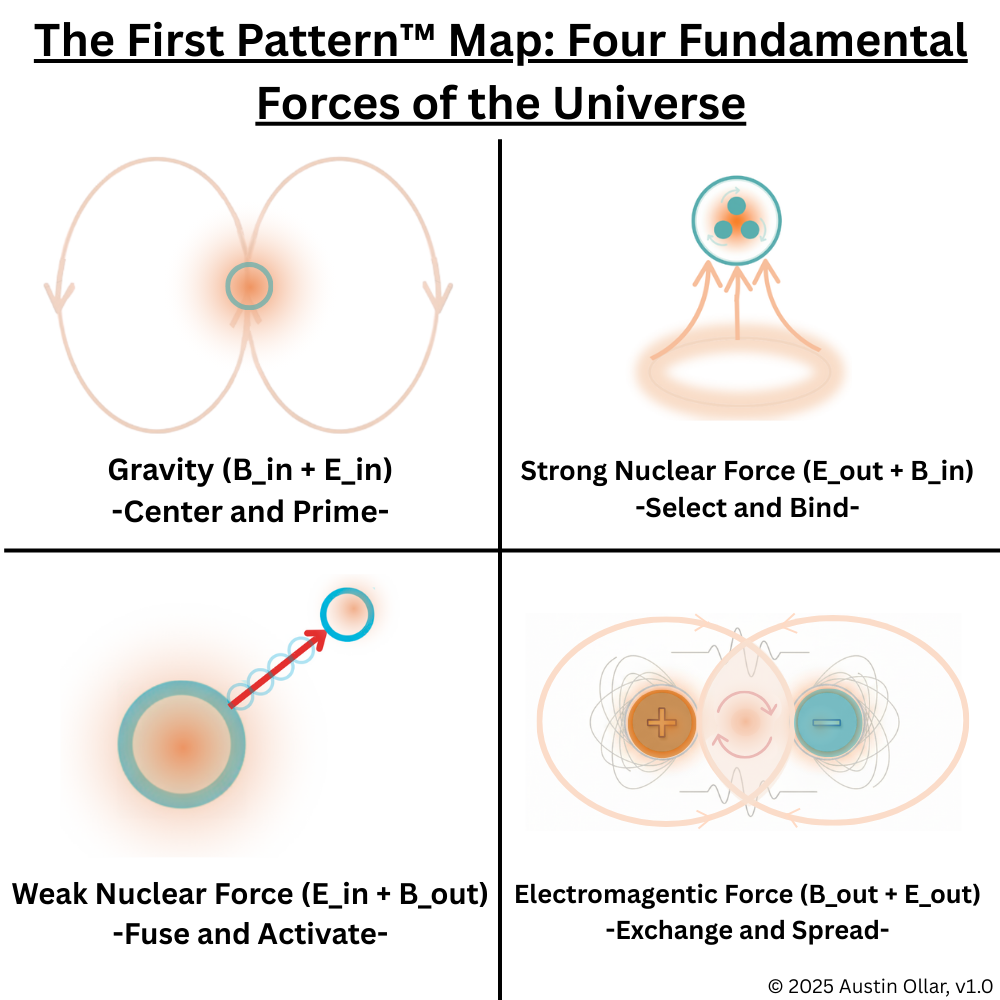
Prime (Q1):
Gravity shows how systems begin by centering potential. Bind Inward pulls matter toward a shared core, and Explore Inward searches for the most stable arrangement around that core. This combination creates the familiar gravitational well that gathers planets, stars, and galaxies. In TFP terms, gravity is the clearest example of Q1: a move that concentrates possibility, builds stability, and primes everything that follows.
Bind (Q2):
The strong nuclear force demonstrates the selective stage of the pattern. Explore Outward tests nearby configurations, sensing which particles can form a tightly aligned structure. Bind Inward then locks those selected pieces into an extremely dense nucleus. This is Q2 at the physical level: a sharp decision point where only specific combinations are allowed, giving rise to atoms with precise rules and stable identities.
Fuse (Q3):
The weak force highlights transformation inside a system. Explore Inward probes the internal state of a particle and destabilizes it just enough to allow change. Bind Outward commits to a new configuration by releasing new particles that broadcast the transformation. This is Q3 in action: a shift that redefines what is inside and sends activation signals outward, allowing matter to evolve and form new pathways.
Exchange (Q4):
Electromagnetism reveals the outward flow stage of the cycle. Bind Outward creates structured links between charges, and Explore Outward sends influence along those links as currents, fields, and light. This outward movement matches Q4, a phase where systems express themselves, exchange energy, and extend connections across space. It is the force that enables communication, interaction, and the propagation of organized patterns.
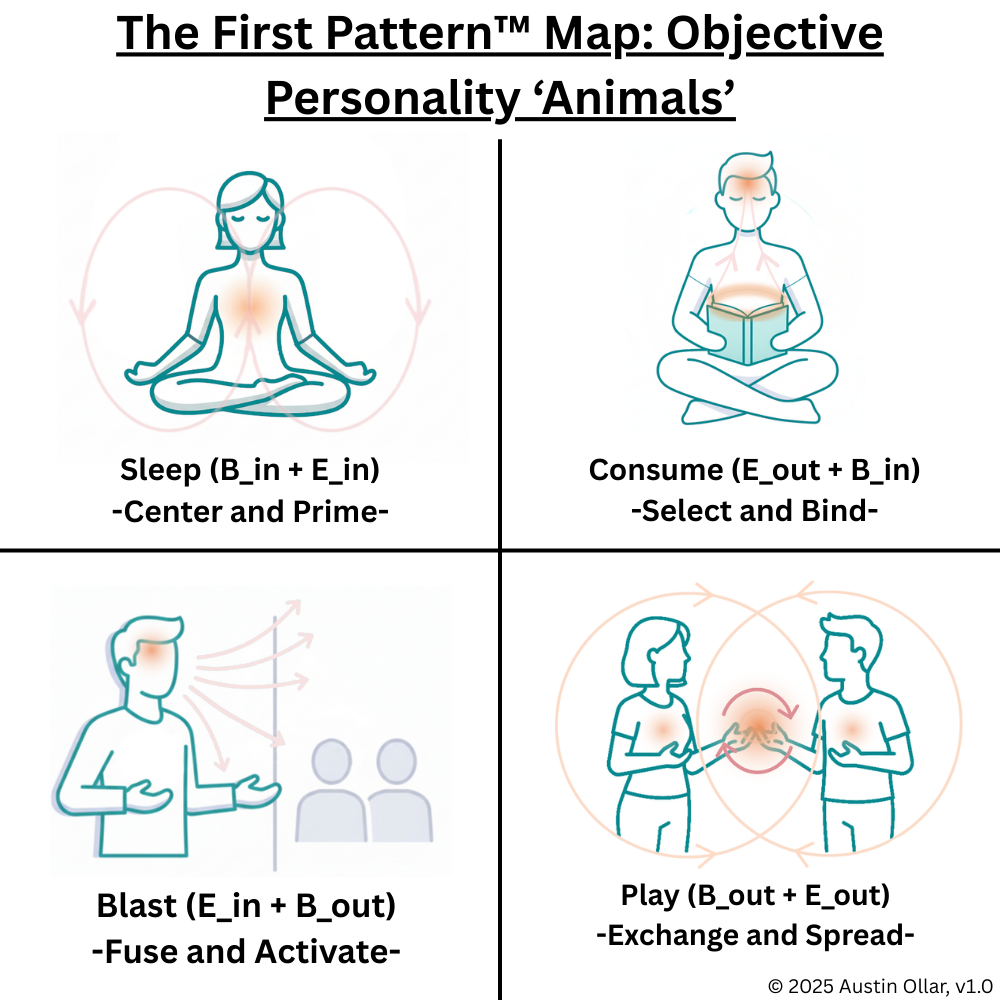
Prime (Q1):
Sleep reflects the inward stabilization move. Bind Inward protects and consolidates personal energy, while Explore Inward reviews patterns, impressions, and internal trajectories. This creates a centered state where the system primes itself before taking action. In TFP terms, Sleep mirrors Q1 by restoring equilibrium, refining understanding, and preparing the self for future movement.
Bind (Q2):
Consume shows how the mind selects and locks onto relevant information. Explore Outward looks for data, patterns, and insights in the environment, and Bind Inward pulls the useful pieces into a stable internal framework. This is Q2 in a psychological form: exploring possibilities, choosing what matters, and integrating information in a way that resonates or helps you understand.
Fuse (Q3):
Blast represents internal synthesis turning into outward communication or expression. Explore Inward processes and organizes ideas, then Bind Outward pushes that structure into the world as direction, explanation, or instruction. This is the Q3 transformation move: fusing internal conclusions and activating them externally so others can align with the system’s logic or plan.
Exchange (Q4):
Play highlights outward interaction and adaptation. Bind Outward creates responsive links with other people or the environment, and Explore Outward moves through those connections, gathering feedback and adjusting in real time. This is Q4 in a human context: a dynamic exchange cycle where energy flows between individuals and patterns propagate through shared activity.
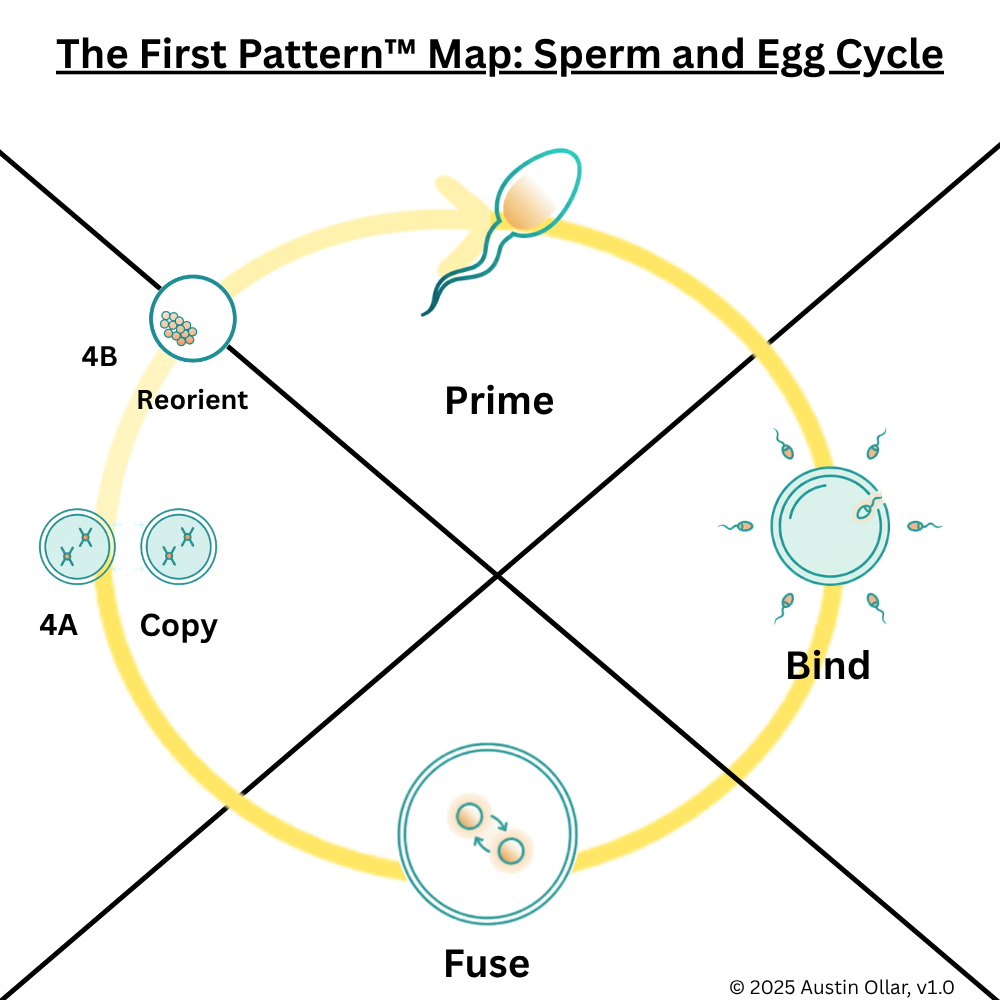
Prime (Q1):
The cycle begins with the sperm entering a state of readiness. It stores potential energy, aligns its internal structure, and prepares for directional movement. This reflects the Q1 dynamic of centering and priming. The sperm is not yet interacting with the egg; it is stabilizing itself and building the momentum needed for the next stage.
Bind (Q2):
When the sperm reaches the egg, the selection process begins. Only specific sperm can attach and penetrate, guided by surface markers and compatibility cues. This is Q2 in action, where the system filters possibilities and binds the correct pair. The sperm and egg meet, recognize each other, and initiate the selective lock that drives fertilization.
Fuse (Q3):
After binding, the sperm enters the egg and their genetic material merges. This is the Q3 transformation stage. Two separate structures reorganize into a single unified pattern. The fusion triggers activation cascades inside the cell, shifting the system from selection to growth and preparing the zygote for replication.
Deploy (Q4):
Copy (4A): Once fused, the new organism begins copying its genetic information through rapid cell division. This is propagation in its pure form, where a successful pattern replicates outward. As long as internal exchange and signaling pathways remain stable, the cycle stays in 4A, multiplying structure and building momentum.
Reorient (4B): When copying can no longer continue in the same way, the system shifts to 4B. Signals redirect the developmental pattern, causing cells to differentiate and organize into new layers and structures. 4B appears when propagation slows and the system must reorient, sending the pattern back into the broader reproductive and ecological cycle.
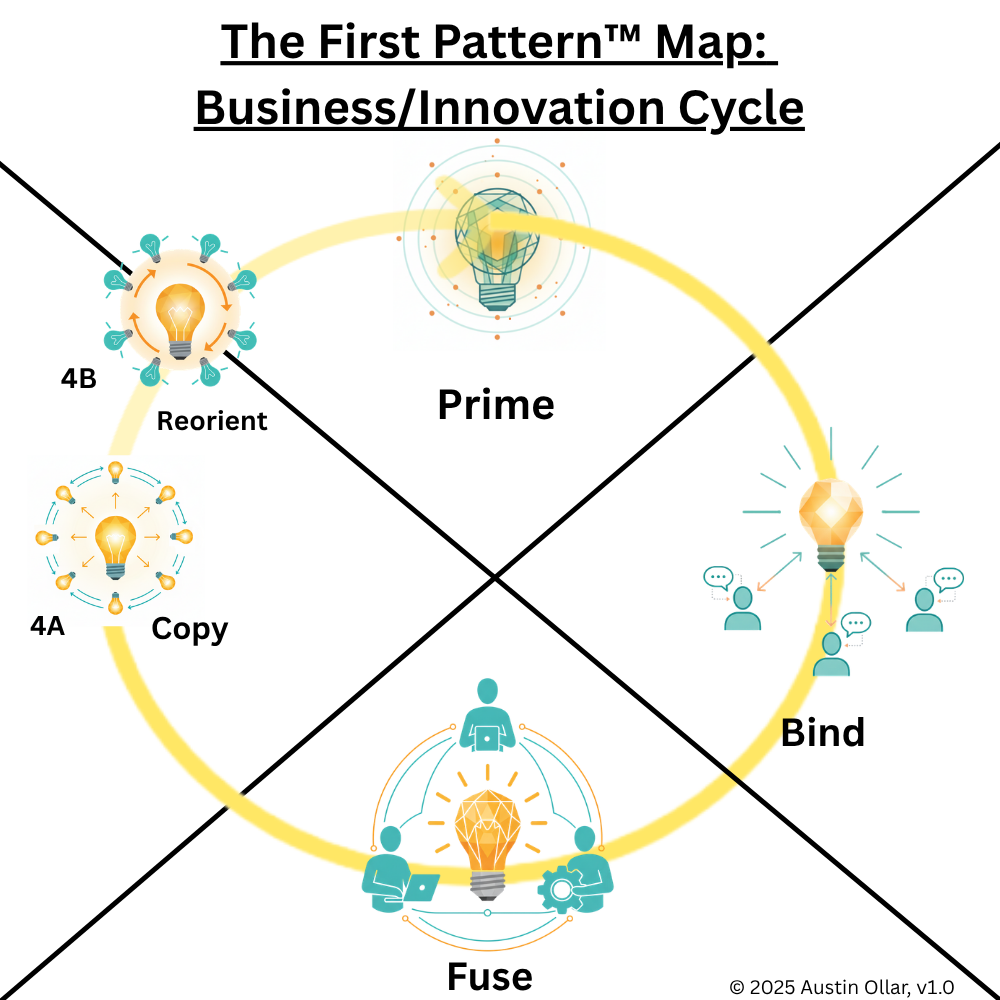
Prime (Q1):
Innovation begins in a quiet internal stage. Individuals or teams gather insights, reflect on problems, and prepare the ground for a new idea. This is the priming phase where patterns are observed, possibilities are explored, and the core concept starts to take shape. It matches Q1: a stabilizing inward move that concentrates potential and gets the system ready for action.
Bind (Q2):
Once a promising idea emerges, the next step is to define it and align people around it. This is where feedback, collaboration, and early validation happen. The team selects the essential elements, filters out weaker options, and binds around a shared direction. This reflects Q2, where the system makes a clear choice and commits to a specific concept.
Fuse (Q3):
The idea becomes real when it is transformed into a working product, prototype, or business model. Teams integrate skills, resources, and structures to build something coherent that did not exist before. This is Q3: the transformation stage where separate parts merge into a unified solution that can stand on its own.
Deploy (Q4):
Copy (4A): Once the idea is validated and functioning, the business focuses on replication. This includes scaling processes, repeating what works, acquiring customers, expanding distribution, and reinforcing successful patterns. 4A is pure propagation: the process that multiplies the core idea across markets and channels.
Reorient (4B): Eventually, growth by copying slows and patterns that once worked begin to plateau. The system shifts into reorientation. Strategies adapt, products pivot, and new directions are explored. 4B appears when continued replication is no longer sufficient, prompting the cycle to reset. The contents of the insight then feeds back into a new round of Prime, Bind, Fuse, and Copy, keeping the business ecosystem alive and evolving.
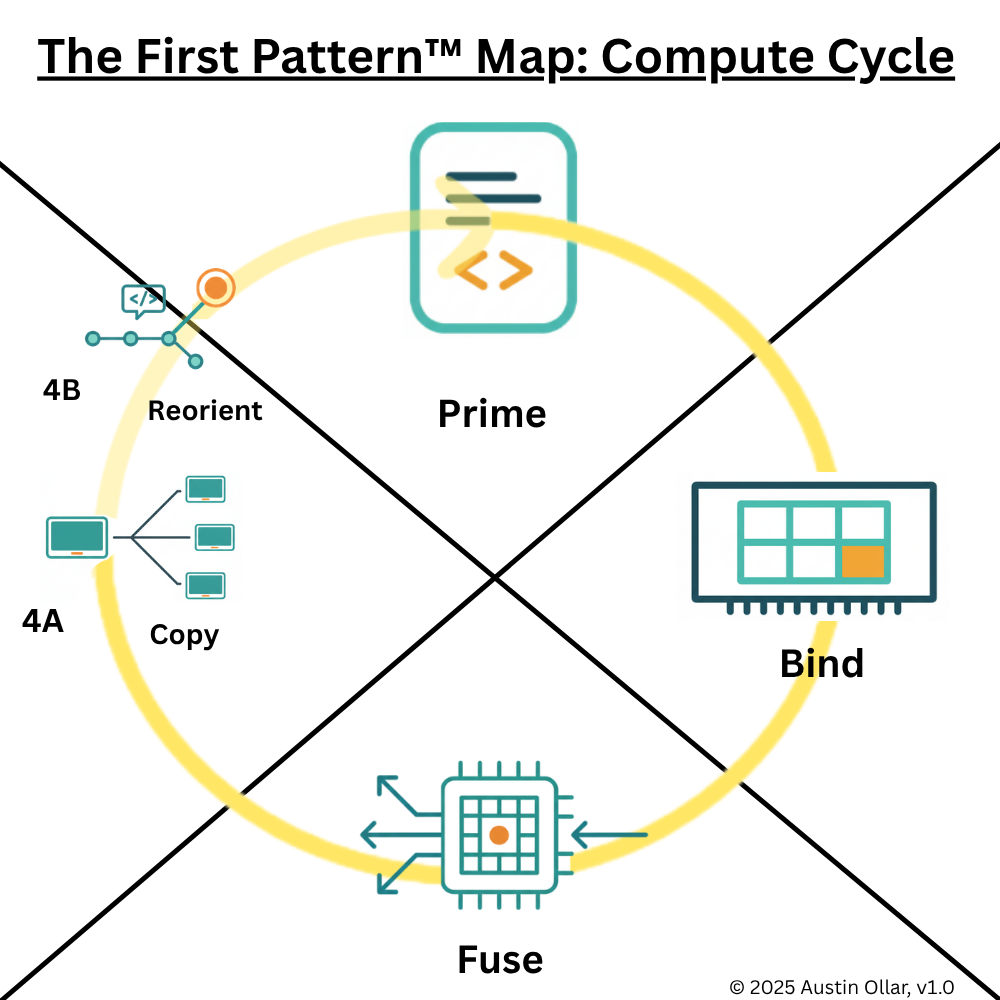
Prime (Q1):
Computation begins with preparation. The system receives instructions, loads code, and organizes the inputs it needs to work with. This is the setup stage where the processor or program stabilizes its state and builds the context for the task ahead. It reflects Q1, the inward priming move that assembles potential before any selection or execution takes place.
Bind (Q2):
Q2 in computation is the memory stage. The system selects which data it needs, retrieves the correct values from memory, and binds them to registers or local storage. Addresses are resolved, variables are loaded, and the program locks onto the specific pieces of information required for the upcoming operation. This is the selection and alignment phase where the computational pathway becomes clear.
Fuse (Q3):
The processor performs the actual computation. Instructions are executed, logic is applied, and inputs are transformed into outputs. Different components of the system work together to fuse data, operations, and rules into a coherent result. This is Q3 transformation, where the internal pattern changes and new information is created.
Deploy (Q4):
Copy (4A): Once the result is produced, it is replicated or distributed as needed. The system may store the output, pass it to other modules, or propagate it across a network. 4A is the propagation phase, where successful computations are repeated, cached, or shared to increase stability and efficiency.
Reorient (4B): When the environment changes, or when copying and repetition are no longer sufficient, the system must reorient. This may involve updating models, recompiling code, reallocating resources, or routing data through new paths. 4B appears when the computational pattern must adjust, feeding back into a new round of Prime, Bind, Fuse, and Copy.
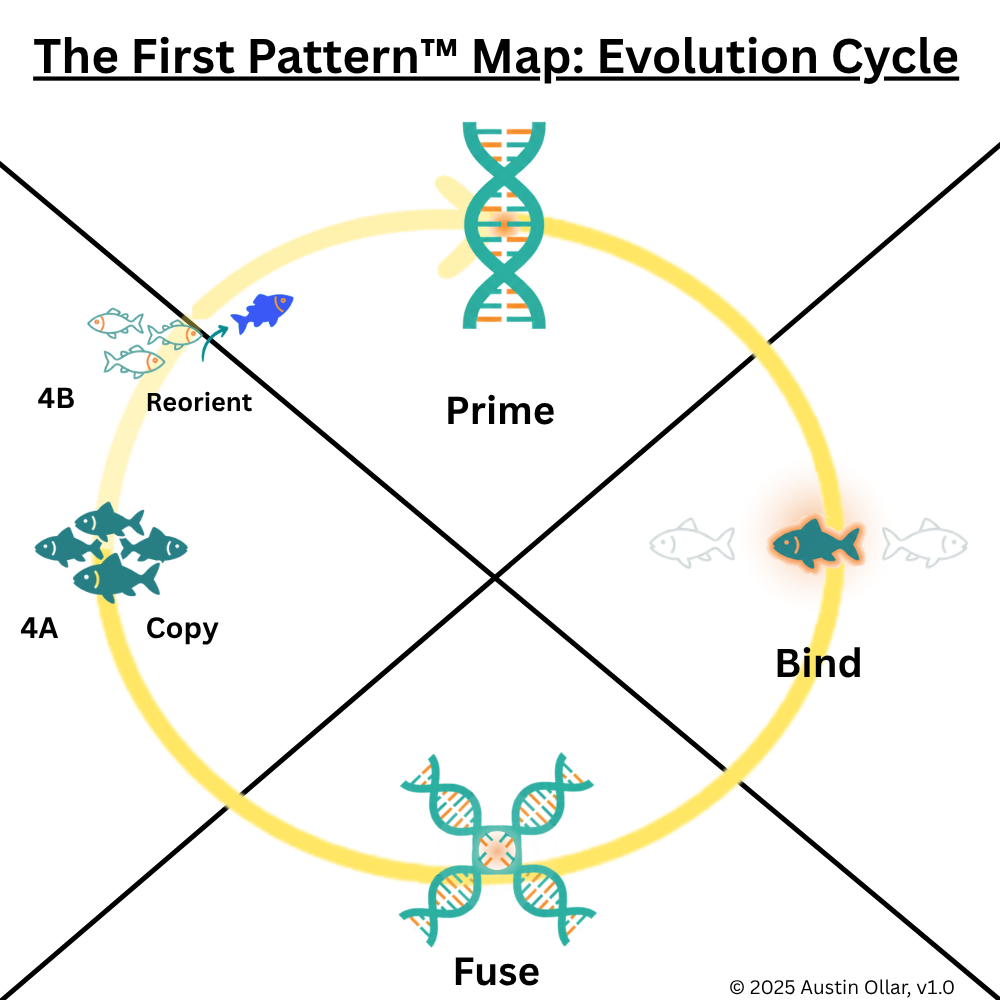
Prime (Q1):
Evolution begins with raw genetic potential. DNA carries variations, mutations, and latent traits that may or may not become useful. This stored diversity provides the groundwork for adaptation. In TFP terms, this is Q1: a centered reservoir of potential that stabilizes the organism and prepares it for selective pressures.
Bind (Q2):
Environmental pressures act as a selector. Certain traits bind to survival and reproduction because they fit the demands of the environment better than others. Predators, climate, and competition filter the population, allowing only specific variants to succeed. This is Q2 selection in its purest form, where nature chooses which traits advance into the next generation.
Fuse (Q3):
Traits that succeed become integrated into the lineage through mutation, recombination, and genetic mixing. Populations incorporate beneficial changes, transforming the genetic pattern and creating new species or subspecies over time. This is Q3 transformation, where internal structure evolves and new forms emerge.
Deploy (Q4):
Copy (4A): Successful genetic patterns spread as organisms reproduce. Offspring carry the selected traits forward, amplifying them within the population. This is 4A propagation, where evolutionary success is replicated repeatedly across generations, stabilizing the new pattern.
Reorient (4B): When conditions change or when copying no longer supports survival, the lineage must reorient. New pressures emerge, environments shift, and previously successful traits become less effective. This forces populations to adapt again, redirecting the evolutionary path and feeding the cycle back into a new round of Prime, Bind, Fuse, and Copy.
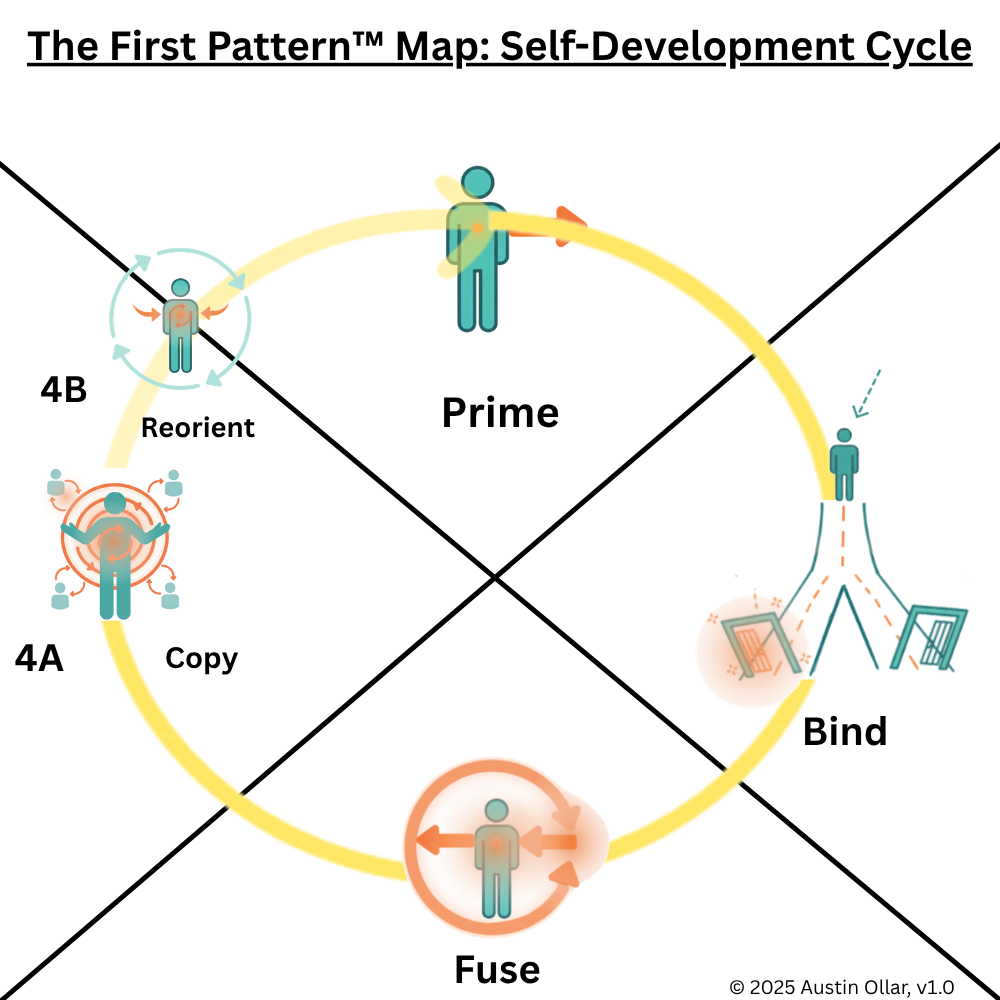
Prime (Q1):
Self development begins with inner potential. A person senses interests, strengths, values, and unrealized abilities, even before they know where these will lead. This internal clarity forms a kind of signal or pull, preparing the individual for meaningful direction. This is Q1: a centered state where inner possibility stabilizes and begins to take shape.
Bind (Q2):
The next stage is the meeting point between inner potential and the outside world. Certain opportunities, environments, or challenges naturally resonate because they match the person’s emerging strengths or interests. It can feel as if the environment is selecting them as much as they are selecting it. A direction stands out, commitment follows, and intentional movement begins. This is the Q2 selection stage, where the self binds to a path that fits who they are becoming.
Fuse (Q3):
Once a direction is chosen, the person begins creating the first stable expression of their emerging identity. Skills start to crystallize, habits align, and they produce an initial form of contribution that is small but functional, like a personal MVP. It is enough to demonstrate that their inner growth can take shape in the outside world. This is Q3 transformation, where the internal pattern and lived experience fuse into something coherent that can stand on its own and begin influencing others.
Deploy (Q4):
Copy (4A): After the first stable expression of growth appears, the person begins to expand it. The MVP version of their contribution becomes repeatable, teachable, and shareable. Skills deepen through practice, and the impact they make on others becomes more consistent. This is the stage where their personal pattern starts to replicate across relationships, projects, and communities. In 4A, self development scales outward, turning early progress into a reliable contribution that supports and uplifts others.
Reorient (4B): Eventually, the pattern that once scaled begins to level off. The contribution no longer grows in the same way, or the person senses that their direction no longer reflects who they are becoming. This triggers 4B reorientation. They pause, reassess, and redirect their path to stay aligned with new potential. This stage closes the loop by feeding back into a renewed round of Prime, keeping growth continuous and self correcting.
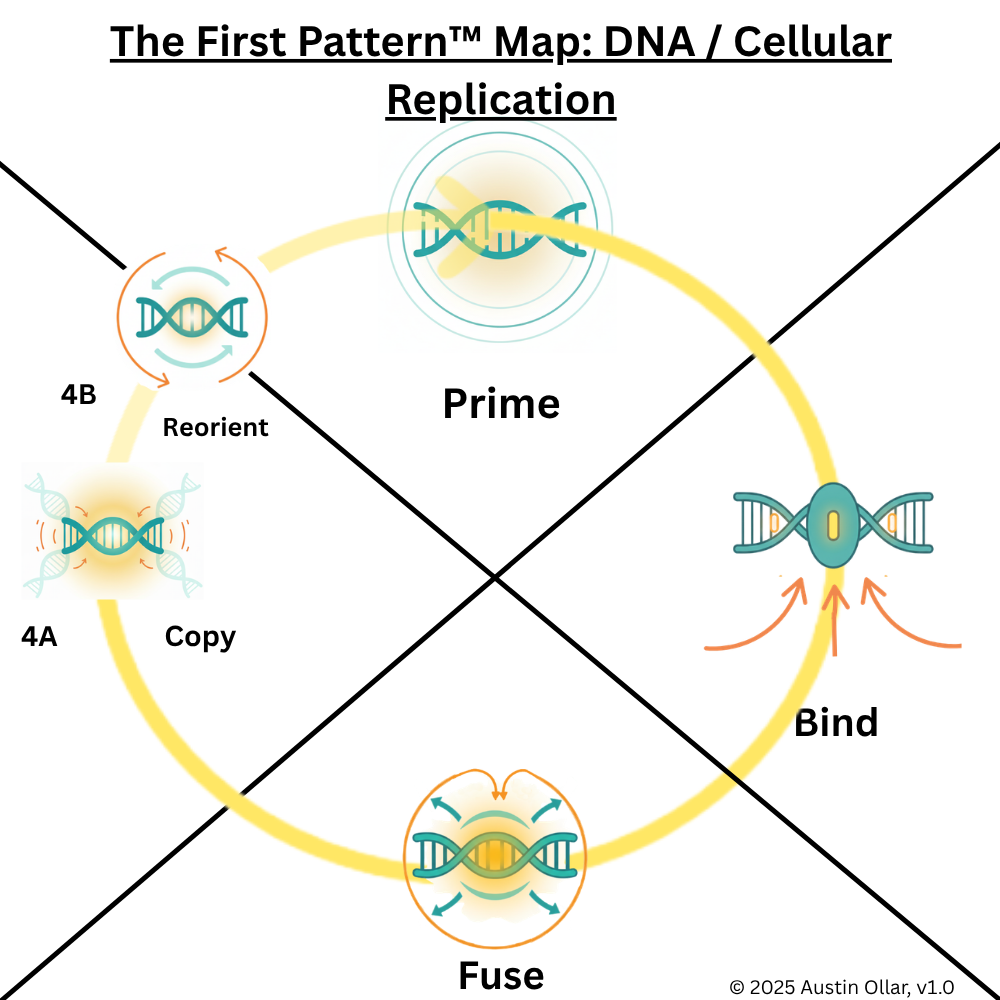
Prime (Q1):
Replication begins when the DNA molecule stabilizes and prepares for duplication. The strands store the full pattern of genetic information in a centered, inactive form. This primed state contains all the potential needed for the next round of copying. It reflects Q1, where the system gathers and holds the blueprint before any selection or separation takes place.
Bind (Q2):
Specific enzymes recognize and bind to the DNA at the origin of replication. Helicase attaches and begins separating the strands, creating a replication fork. This selective interaction is Q2, where the system chooses the exact site and tools needed to unlock the pattern and open it for transformation.
Fuse (Q3):
New nucleotides are matched to each exposed strand and fused into growing daughter strands. Polymerase connects these nucleotides into a coherent sequence, integrating new material with the original template. This is Q3 transformation, where the pattern turns into a new form and the internal structure of the molecule changes as replication proceeds.
Deploy (Q4):
Copy (4A): The DNA strands continue to elongate as the replication machinery copies the genetic code along both forks. Successful sequences are repeated base by base, producing two complete and identical DNA molecules. This is 4A propagation, where the system multiplies the pattern with precision and stability.
Reorient (4B): Once copying is complete, the strands detach from the replication machinery and reorient into their proper double helix forms. Final proofreading, corrections, and finishing steps take place to ensure structural integrity. This prepares the DNA for the next cycle and feeds back into a fresh Prime state. This is 4B reorientation, where the copied pattern resets into a stable configuration for future use.
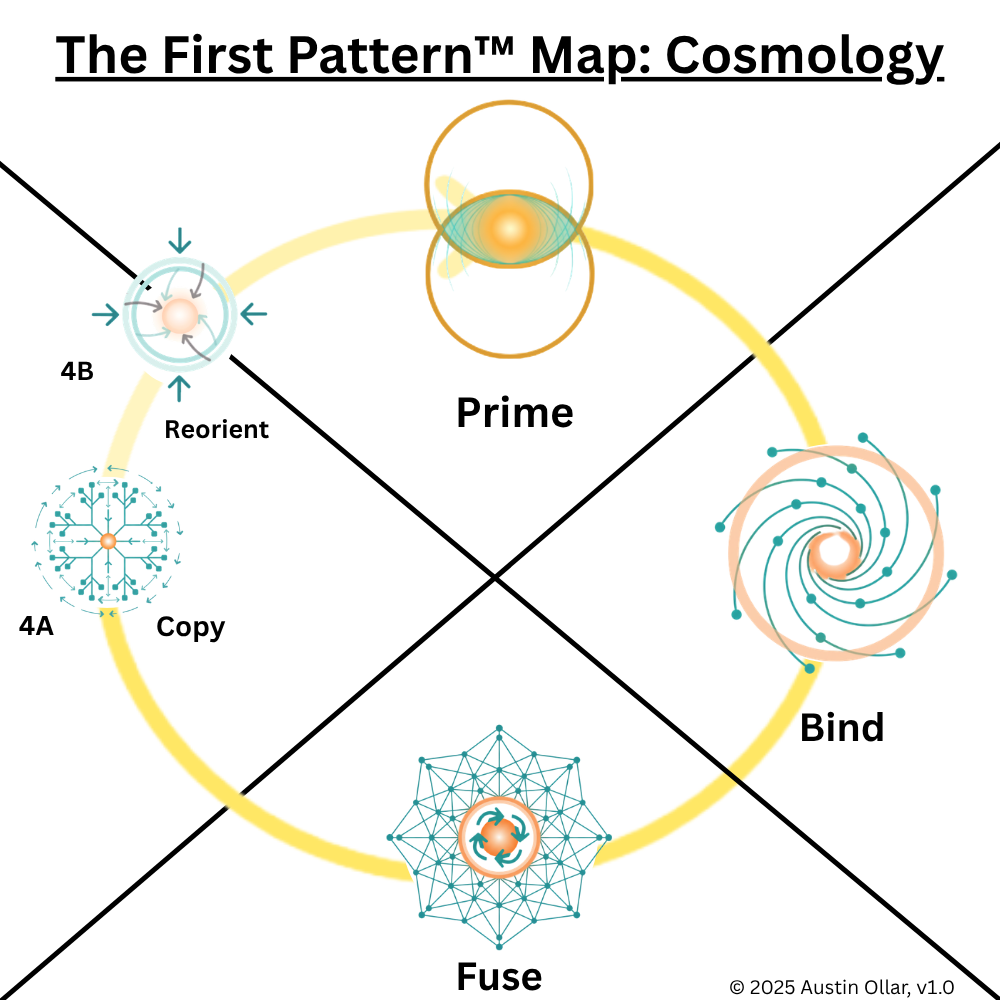
Prime (Q1):
The cycle begins at the singularity, a state where all matter, energy, space, and time are compressed into one concentrated point. Nothing is differentiated yet, and no large scale movement or structure exists. This is Q1 in its purest form: maximum potential held in a single unified state before any expansion, selection, or organization begins.
Bind (Q2):
As the universe rapidly expands, gravity begins to act as an external selector. Even though gravity reflects the Q1 nature of centering and pulling inward, in this stage it shapes which regions of matter will gather into structure and which will thin out. Tiny fluctuations grow as some areas are drawn together while others drift apart, forming spirals, filaments, and early galactic seeds. This is Q2 selection at the cosmic scale, where gravitational sorting determines which regions will become the anchors of future structure.
Fuse (Q3):
Inside these gravitationally bound regions, matter transforms. Stars ignite through nuclear fusion, heavy elements are forged, and complex structures emerge from simple beginnings. Galaxies, solar systems, and networks of stars take shape. This is Q3 transformation, where the raw material of the universe fuses into new forms that did not exist before.
Deploy (Q4):
Copy (4A): Once the pattern of stars and galaxies becomes stable, it repeats across billions of light years. Similar structures form in many regions, following the same underlying rules. Star formation, element creation, and galactic evolution replicate throughout the cosmos. This is 4A propagation, where the successful structure of the universe spreads outward as space continues to expand.
Reorient (4B): Over enormous stretches of time, the available energy for star formation diminishes, galaxies drift apart, and the universe slowly quiets. Some theories propose that extreme conditions, such as black hole singularities or vacuum fluctuations, could seed the next cycle. This is 4B reorientation: the old pattern winds down, conditions shift, and the remaining energy may curve back into a new Prime, restarting the cosmic story.